

Online Leak Sealing of Ammonia Vapour and Carbamate Liquid Leak from a 1.8 m Flange in a Chemical Plant
In a chemical plant, a major leakage was observed from a large-diameter flange handling ammonia vapour and carbamate liquid. The flange had an outside diameter of approximately 1.8 metres, with a significant gap of around 32 mm between the flange faces.
The equipment was operating at 75 bar pressure and 170°C temperature. Due to the hazardous nature of the process medium and the high operating pressure, the leakage presented a serious safety, environmental and production-continuity concern.
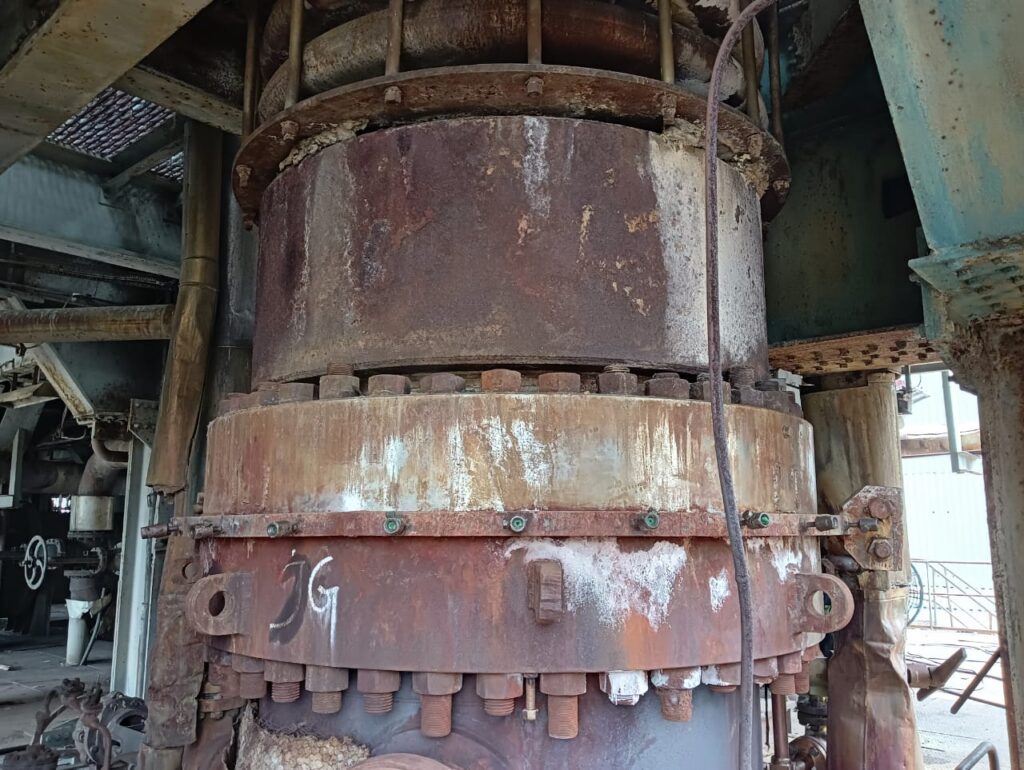
Conventional repair would have required shutdown, isolation, depressurisation and dismantling of the flange assembly. Given the equipment’s criticality and potential production loss, the plant required an engineered online leak-sealing solution that could arrest the leakage while the system remained in operation.
NESL responded with a bespoke clamp-based online leak sealing solution, supported by in-house clamp design, workshop fabrication and controlled injection of NES-2B sealing compound.
The Engineering Challenge
This was not a routine flange leak. The large flange diameter, wide flange gap and hazardous service made the job technically demanding.
A 32 mm gap between flange faces creates a substantial leakage path. At 75 bar, the escaping ammonia vapour and carbamate liquid could not be treated as a minor gasket leak. Any uncontrolled discharge had the potential to expose nearby personnel, accelerate corrosion around the joint, affect adjacent structures and force an unplanned shutdown.
The repair had to address several critical factors:
- containment of a hazardous ammonia and carbamate service;
- sealing of a wide leakage path around a large-diameter flange;
- controlled injection without over-stressing the existing flange assembly;
- compatibility of sealing compound with the process medium and temperature;
- safe installation of the clamp under live plant conditions;
- restoration of containment without disturbing plant operation.
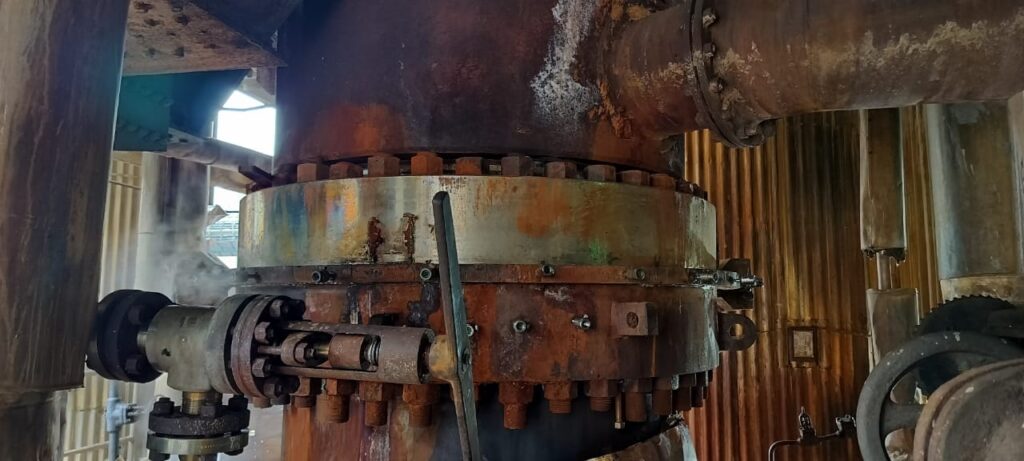
The photographs show the scale of the flange and the complexity of the installed clamp arrangement. The solution required accurate site measurement, proper sealing cavity design and careful planning of injection points around the circumference.
Bespoke Clamp Design and Fabrication
Based on site dimensions and the leakage geometry, NESL designed a bespoke clamp suitable for installation around the 1.8 m OD flange.
The clamp was fabricated in NESL’s own workshop, allowing the repair to be tailored to the actual flange profile, available clearances, bolt layout and sealing requirement. The clamp was designed to create a controlled sealing cavity around the leaking joint and to provide multiple injection points for uniform distribution of the sealing compound.
For such applications, clamp design is an integral part of the repair. The clamp is not merely a cover; it becomes part of the temporary pressure-containing sealing system. Therefore, the design and fabrication approach considered the operating pressure, temperature, flange condition, installation constraints and compound injection requirements.
The Online Leak Sealing Approach
After fabrication, the bespoke clamp was transported to site and installed around the leaking flange. Once the clamp was secured in position, injection fittings were prepared for controlled introduction of the sealing compound.
NES-2B compound was selected for the application considering the process medium, operating pressure and temperature.
The compound was injected progressively through the installed injection points. The objective was to allow the compound to travel through the sealing cavity and occupy the leakage path between the flange faces. Injection was carried out in a controlled sequence to build sealing resistance gradually and avoid sudden pressure imbalance within the clamp cavity.
As the compound filled the leakage path, the discharge of ammonia vapour and carbamate liquid reduced progressively. Injection continued until the leakage was fully arrested and the joint condition was stabilised.
The repair was completed online, without dismantling the flange and without requiring immediate shutdown of the equipment.
Result
The online leak sealing intervention successfully arrested the ammonia vapour and carbamate liquid leakage from the large-diameter flange.
Following completion:
- the hazardous leak was contained;
- the equipment remained in service;
- an unplanned shutdown was avoided;
- exposure risk to operating personnel was reduced;
- process loss and environmental risk were controlled;
- the plant gained time to plan permanent maintenance during a scheduled shutdown.
Why This Repair Matters
Large-diameter flange leaks in ammonia and carbamate service are among the more challenging online leak sealing applications. The risk is not limited to product loss. Such leaks directly affect plant safety, equipment integrity, environmental compliance and production reliability.
This case demonstrates the importance of combining field assessment, engineered clamp design, in-house fabrication and controlled compound injection. The sealing compound alone is not the solution. Successful online leak sealing depends on the complete engineered arrangement: clamp design, sealing cavity, injection strategy, compound selection and safe field execution.
For chemical and fertilizer plants, this approach provides a practical means of maintaining containment and avoiding costly production interruption where shutdown-based repair is not immediately feasible.
Standards and Engineering Reference
Online leak sealing of pressure equipment should be approached as an engineered temporary repair. The repair philosophy should consider applicable pressure containment principles, ASME PCC-2 guidance for repair of pressure equipment and piping, and relevant Indian requirements such as BIS IS 18159:2023 covering online leak sealing compounds and clamp / enclosure design.
In this case, the bespoke clamp and NES-2B injection system were applied as an engineered sealing arrangement to restore containment under live operating conditions.
